

The Madagascar lace plant has long charmed home aquarium owners with its signature perforated leaves, but it is also beloved by researchers in 海角社区app鈥檚 .

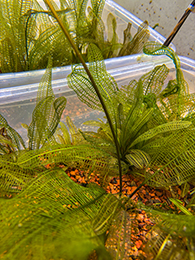 鈥淭he lace plant has thin, semi-transparent leaves, allowing us to watch听 programmed cell death (PCD) happen in real time under the microscope,鈥� explains Dr. Arunika Gunawardena.
Understanding PCD 鈥� the genetic process where cells that are no longer useful die 鈥� has many applications in agriculture and cancer research.
The problem for the Biology professor and her students is that it is notoriously difficult to induce flowering and obtain seeds from the endangered lace plant outside of its natural island home off the southeast coast of Africa.
鈥淭here is no way we can purchase seeds,鈥� she says.
There is another option, though. Tissue culture 鈥� a lab-grown process that uses parts of a healthy plant to produce replicas for research 鈥� is the best approach, but there are limits.
There is no way we can purchase seeds.
鈥淭he problem is that plant vigor tends to go down over time, so getting new seeds to restart the culture is a really big deal,鈥� explains Valerie Schagen, a master鈥檚 student in Dr. Gunawardena's lab.
To establish a sustainable supply and push their research program forward, the lab needs their plants to flower and produce seeds 鈥� something the team has not achieved in a decade.
Until recently.
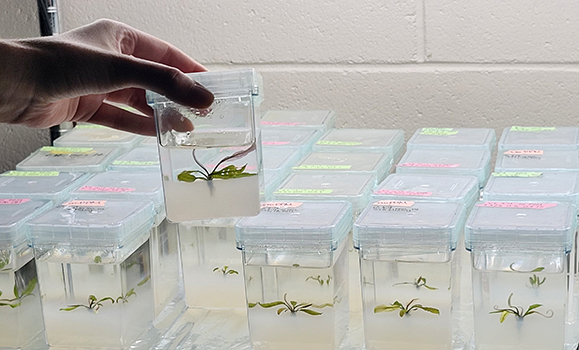
Seedlings that turn into mature plants will be used for tissue culture, creating a new line of genetically identical plants.
Creating island conditions
Seeking a better environment for growing the plants, Dr. Gunawardena decided to explore an in-house solution: Dal鈥檚 Aquatron Laboratory.听
Aquatron manager John Batt provided a small space in the facility鈥檚 wet labs in 2024 for a pilot project. Operations technician Jim Eddington and biologist Nayla Sernowsky set up two tanks with different water flow speeds for the fully aquatic plants.
鈥淢imicking the required environmental conditions in the Aquatron is more realistic than a laboratory tank setting,鈥� says Rajesh Rajaselvam, a Biology prof who advised on ecological matters.
One element of nature the Aquatron can鈥檛 account for is pollinators, so when flowers bloomed, they were hand-pollinated using a paintbrush.
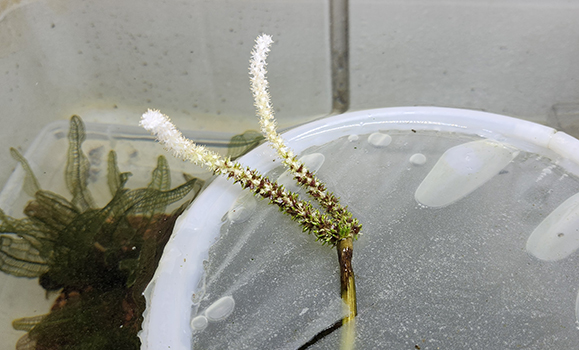
When flowers bloomed, they were pollinated by hand with a paintbrush.
Despite the team鈥檚 efforts, their first flowers died without producing seeds. Eddington suggested a homemade humidity chamber to cover the flowers to better mimic Madagascar鈥檚 conditions.
鈥淭hat鈥檚 the secret,鈥� says Dr. Gunawardena. 鈥淚t produced a lot of seeds.鈥�
Culture club
From there, seeds were carefully collected, with听Schagen and undergraduate summer research student Abi Dixon testing different conditions to see what best causes germination and leads to healthy growth.
Currently, the wait is on to see which of the over 50 seedlings turn into mature plants suitable for tissue culture. 鈥淭he new tissue culture system will have more genetic diversity and provide more accurate data overall,鈥� says Dixon, who will pursue an Honours project this fall and is among the past and present students to have individually blossomed throughout.
The new tissue culture system will have more genetic diversity and provide more accurate data overall.
Involved from the beginning, Alliyah Borrowman (BSc鈥�25) helped design the experiment and collected data on plant growth for her independent research course. 鈥淢y time at the Gunawardena lab played a crucial role in getting accepted into graduate studies,鈥� she says. 鈥淎runika and Rajesh provided me with an amazing opportunity to learn how to conduct research, give presentations, and write scientific reports.鈥�
Jake Gysel came on board in January, building on Alliyah鈥檚 work and incorporating his own research interests, adjusting the plant鈥檚 carbon-to-nitrogen ratios as a global warming simulation of sorts. 鈥淚 want whatever I do in life to be about solving problems related to climate change,鈥� says Gysel, who鈥檚 graduating this spring and recently started working as an environmental consultant.
The project will also support Schagen鈥檚 research. 鈥淲e鈥檙e curious about whether plants grown in realistic conditions versus the culture room might have different chemical profiles,鈥� she says, noting that harvested leaves grown are being frozen for future analysis.
Watch Schagen鈥檚 presentation from the 2026 3 Minute Thesis finals:
Seeds of success
Findings from this project will be documented in an upcoming research paper.
鈥淲e want to get reproducible results and ensure we have a proper protocol. We don鈥檛 want to get flowers once every 10 years,鈥� says Dr. Gunawardena, adding that the collaboration between faculty, students, and staff has been the highlight.
That鈥檚 the beauty of this research project: everyone鈥檚 contributions.
鈥淭hat鈥檚 the beauty of this research project: everyone鈥檚 contributions.鈥�
Batt agrees: 鈥淭his is a great example of people coming together to share ideas.鈥�