

The College of Sustainability knows that the recipe for success is hard work, creativity, and just a little magic.
It鈥檚 also the recipe for the Sustainability Leadership Certificate program, a series of weekend modules, action projects, written reflections and creative assignments spread over the school year to expose students to new methods of cultivating sustainability.
Susan Tirone, the certificate鈥檚 coordinator, has been developing the program for over a year. After many consultations with students, it became clear they wanted more than just classroom experience.
鈥淪tudents said, 鈥榃e already volunteer; we want more sustainability in the stuff we鈥檙e already doing,'鈥� says Dr. Tirone.
Dr. Tirone developed the certificate鈥檚 curriculum with the help of the College of Sustainability鈥檚 Steven Mannell, Emma Savage and Debra Ross, and in collaboration with community developers Brian Braganza, Cate de Vreede and Leon de Vreede of Ripples 2 Waves consultants from Bridgewater, Nova Scotia.
The certificate was created through 海角社区app鈥檚 Student Engagement Initiative, in partnership with the Centre for Learning and Teaching. The Faculty of Management was a partner during the concept phase, which included input from dozens of participants from across campus.
The program was designed to encourage students to follow their own passions to find ways to incorporate sustainability into all facets of their lives. 聽
And it delivered.
Making waves
Sustainability, in the college鈥檚 view, goes beyond the environment and includes personal and social aspects as well.
The program teaches that being a leader in sustainability requires a few key ingredients: passion, creativity, and community. The goal of sustainability projects should be to create a 鈥渞ipple effect鈥�, causing others to get involved and take similar actions. Dr. Tirone says any activity or project can be a community-building exercise if you use just a little 鈥榤agic鈥� 鈥� making use of the spark that comes when people come together and get excited about a common goal.
Dr. Tirone and the curriculum development team combined these ingredients to turn an otherwise boring task of reporting on the interview assignment into an afternoon in a pseudo-Parisian caf茅. She and the other program facilitators dressed up the boardroom of the College of Sustainability as a caf茅.
鈥淭he caterer liked the idea so much he helped us set up the tables and make everything perfect,鈥� says Dr. Tirone 鈥� magic in action.
Looking to leaders
The first assignment in the program was for students to find leaders they admired and ask them about their leadership style.
鈥淭he leader interviews allow students to go to people in the community that they admire, and see what they do that makes them a leader,鈥� says Dr. Tirone. 鈥淭he goal was for students to pull those skills into their lives and work.鈥�
Students talked to more than 70 leaders, mostly from Halifax but some from as far as Ontario, Alberta, and B.C.
Dr. Tirone says this certificate was based on the ASPIRE model of learning and teaching (an acronym that stands for assessment, setting objectives, planning, implementing, reflection, evaluation).
Students in action
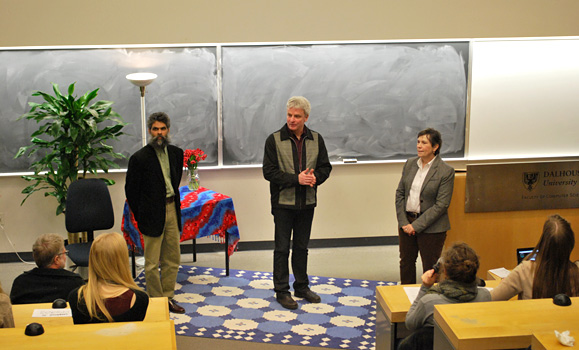
Students put these new tools to the test with their final assignments. Each participant designed an action project that would cultivate sustainability. On March 10, the program facilitators turned an auditorium in the Computer Science building into a cozy living room and shared their action projects with each other, the way a family shares stories around the dinner table.
Shauna Doll developed what she called the "Mended Blender Cafe," a series of workshops designed to teach people how to fix household appliances. While mending their blenders, people could also have a coffee, listen to music and hang out with other menders.
This was her mix of social and environmental sustainability: providing a place for people to get together while learning how to save their appliances from the dreaded landfill.
Doll could have done the job of teaching people to fix appliances by bringing people to a garage full of tools and repair-people. Instead, she threw a little magic into the mix, brought in the concepts of personal and social sustainability, and produced an afternoon of fun, community learning and waste diversion.
Another student, Grace McCaffrey, took a totally different approach to her sustainability project. She wrote anonymous love notes and scattered them around the city 鈥� taped to bus shelters, left in public washrooms, tucked into the pages of library books.
鈥淚 felt like a secret agent trying to hide these letters without anyone noticing,鈥� she said in her presentation.
What do love notes have to do with sustainability? Grace says that sustainability starts when people feel a sense of belonging in a community and her letters would help their readers feel that connection.
Both of these projects started with one person, but aimed for the ripple effect, with results helping more people build sustainability into their lives.
This model is designed to share knowledge between members of the group, including teachers and students, contrasting with the traditional lecture format.
鈥淚鈥檓 a community developer. Top-down doesn鈥檛 work for me,鈥� says Dr. Tirone.
鈥淭his is a program that encourages and gives you a toolkit with which to explore alternative concepts of learning, success, and career,鈥� says participant Benjamin Reid-Howells. 鈥淭hey鈥檙e stressing values that aren鈥檛 usually stressed, like connecting internally with what you鈥檙e doing externally.鈥�
One observer at the action project presentations pointed out that the college鈥檚 biggest strength is helping students to 鈥渕ove forward irrespective of a profit-centred perspective.鈥�
鈥淭his is a party, not a protest鈥�
On the final day of the certificate, program instructor Cate Trueman gave students one last lesson.
鈥淭he most successful (social action projects) are the ones that celebrate their achievements, big or small,鈥� says Trueman. 鈥淭his is a party, not a protest.鈥�
Program host Phoebe Mannell congratulated certificate graduates as they indulged in celebratory cake.
鈥淸This is] more than just a degree that goes on your wall聽鈥� in these modules we have built a community,鈥� she said. 鈥淲e built friendships and helped each other grow.鈥�